
THE NEW ARCHITECTURE OF CONCENTRATION: THE ART OF PRESERVING DIGITAL ATTENTION
Updated: Aug 8
Attention is no longer a flower that blooms spontaneously. In the digital flow of modern life, attention is more like a delicate fabric tossed about in the wind. Every moment a notification, a message, a sound, a light… The human mind is constantly fragmented, the thread of thought tangled. Yet, the reason for this is not technology itself; it is our random, unplanned, and aimless placement of technology.

Concentration today is not a natural phenomenon; it's an architectural task.
Just as a well-designed building can transform a person's movements, breathing, and habits, a well-designed digital system can change the way we think. The point isn't to escape, but to rebuild. Because the digital world is too big for us to escape, but not too rigid for us to reshape.
The new architecture of concentration begins right here.
The idea of consciously organizing the digital space cannot be reduced to a mere technique driven by the pursuit of efficiency. It is an effort to preserve the realm of qualitative thought. Thought seeks to deepen; therefore, it requires an uninterrupted foundation. However, if that foundation is constantly fragmented, the depth of thought becomes difficult to reveal.
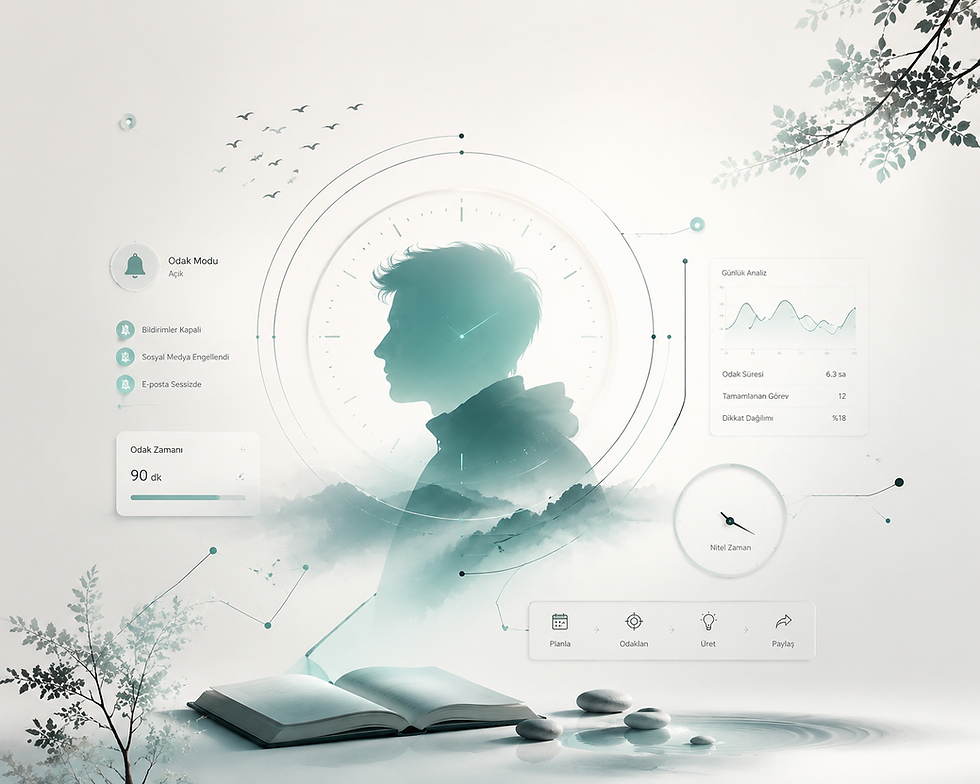
A device being able to turn off all notifications with a single button; automatically switching to silent mode at certain times; activating a profile that blocks out all distractions while working… These seem like small things. But the power of architecture lies precisely in how small details transform into significant changes.
These kinds of digital arrangements don't just make things easier in practice.
It expands mental space.
The most productive moments for thought are those when the mind can move in a steady direction. Digital architecture—the conscious choice of where to place things—creates a framework to prevent the mind from losing this direction. Technology is not an obstacle here; it is like a protective wall built around thought.
Concentration architecture is not a discipline that imposes restrictions.
On the contrary, it is a system that grants freedom to the mind.
Because the goal is not to silence technology; it is to put it at the service of the qualitative. When human attention is maintained, thought takes on a form that is both calmer and more powerful. In today's digital world, depth is only possible through conscious architecture. And this architecture restores to the mind its most natural right: concentration.
In this modern age, attention is lost when left to its own devices.
It grows when it is embraced.

Comments