
IN PURSUIT OF QUALITY TIME: CREATING A HUMAN-CENTERED RHYTHM IN THE DIGITAL WORLD
Updated: Aug 8
The flow of time is no longer determined by a clock, but by a notification rhythm. People become aware that something has ended not so much by their own internal rhythm, but by the sound their device emits. This is one of the quietest transformations of the digital age: time is now managed from the outside.
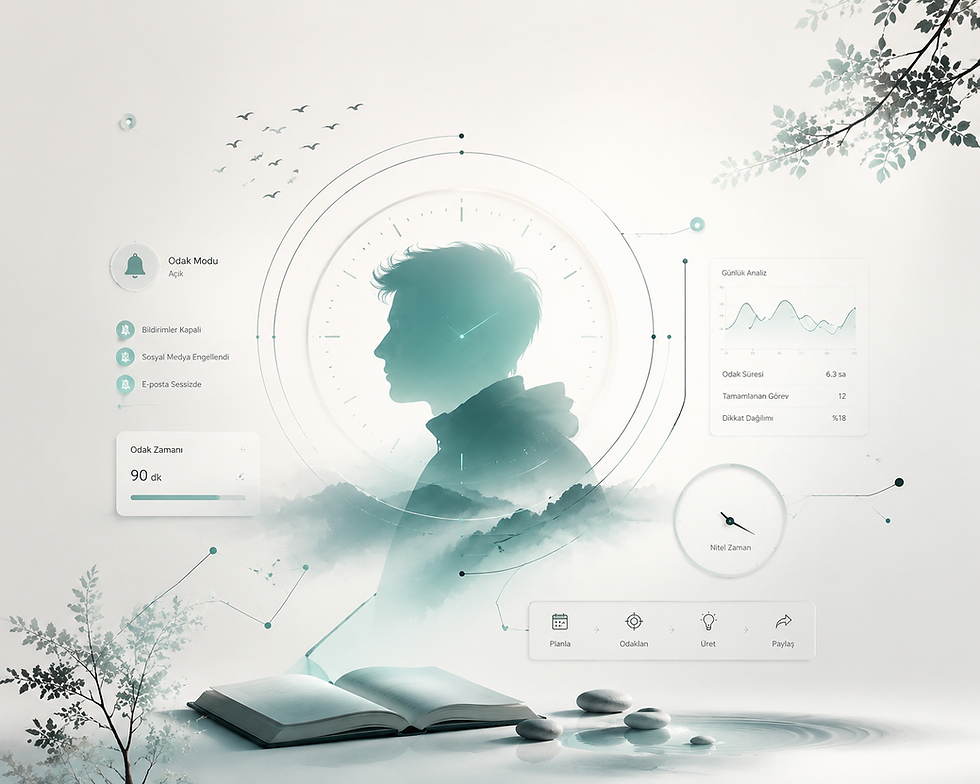
This situation is often described as technology either speeding us up or making us superficial. But it's not about speed; it's about rhythm. Speed alone isn't harmful, as long as you set the rhythm. Digital tools can help you establish rhythm; you just need to learn how to position them outside of your own tempo.
Quality time is when a person is connected to their own rhythm.
It includes moments when a thought can transform from a spark into a complete whole.
And these moments are easily lost in the ceaselessly fragmented digital stream.
The digital world itself isn't the problem here. The problem is the surrender of rhythm to technological triggers. Because the natural flow of the mind progresses over much longer periods than external noises. The slow intensification of an idea, the inner circulation and clarification of an intuition… These are processes too profound for rapid notification cycles to perceive.
Technology is not the enemy of these processes; on the contrary, it can be a tool for preserving qualitative time.
But the condition is simple: the human must decide the rhythm.
This starts with practical arrangements.
The digital calendar marks specific parts of the day as uninterrupted zones.
Notifications automatically turn off in different work modes.
Devices should only provide information flow at specific times.
Although these may seem like mechanical adjustments, their effects are on a mental level. Because rhythm is not created by an external program, but by an internal integrity. When technology is positioned to preserve this integrity, the natural rhythm of human beings becomes visible again.
The real benefit lies here:
When external time pressure decreases, internal time expands.
In the digital age, quality time is not a luxury; it's a necessity. If one wishes to deepen their understanding amidst the superficial flow of information, they must re-establish their rhythm. This rhythm cannot be achieved by escaping technology, nor by completely surrendering to its flow.
Balance lies in transforming technology into an aid that doesn't interfere with the rhythm.
Reclaiming qualitative time changes the relationship a person has with their own thoughts. A broader, calmer, clearer space opens up. Digital tools can expand this space rather than narrow it; provided that the master of time is not technology, but the human being.
In today's world, depth remains on the side of those who seize control of time.


Comments